

Newborn baby vomiting milk after feeding can be alarming, especially when it looks like your baby has brought up the entire feed. However, it’s important to understand that normal spit-up is different from actual vomiting.
Small amounts of breast milk or formula may come back up in young babies because their digestive systems are still maturing. Normal reflux is usually effortless, and babies who are comfortable, feeding well, and gaining weight generally do not need treatment.
True vomiting is different. It is usually more forceful and may happen along with other symptoms, such as diarrhea, fever, feeding refusal, dehydration, or unusual sleepiness.
This guide explains the difference between spit-up and vomiting, the common causes of newborn baby vomiting milk after feeding, what you can safely do at home, and which warning signs deserve prompt medical attention.

Spit-Up vs. Vomiting: What’s the Difference?
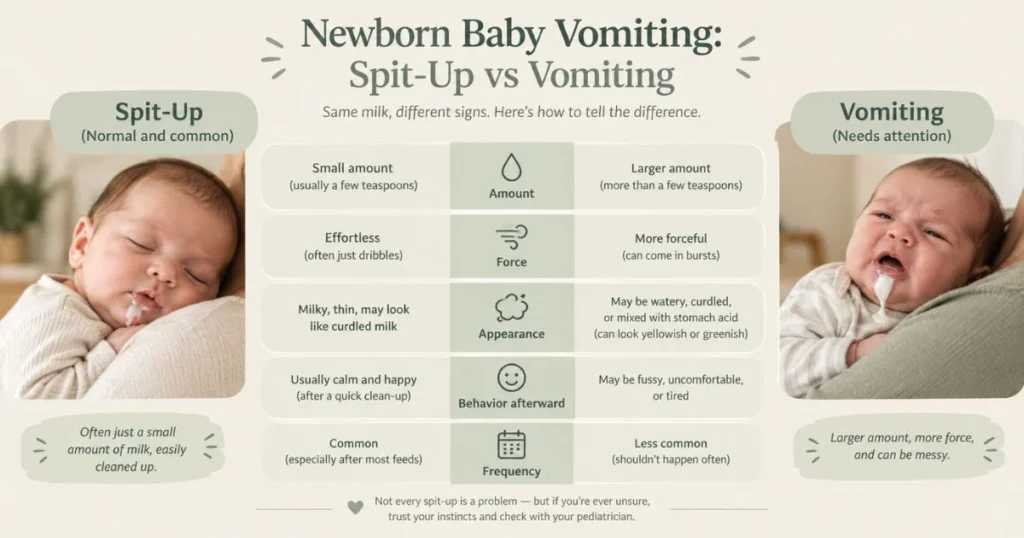
One of the first questions parents ask is whether their baby is actually vomiting.
What Is Normal Baby Spit-Up?
Spit-up, also called gastroesophageal reflux (GER), is the effortless movement of stomach contents back into the esophagus and sometimes When newborn baby vomiting milk after feeding is actually normal spit-up, it may happen during a feeding or shortly afterward. You might see a little milk gently flow from your baby’s mouth or come up when they burp.
Normal spit-up is usually:
- Effortless
- Relatively small in volume
- Close to feeding time
- Not associated with significant distress
- More common during the first year of life
AAP guidance notes that normal infant reflux is common and usually improves as babies mature.
What Does True Vomiting Look Like?
Newborn baby vomiting milk after feeding can sometimes mean true vomiting, which is the forceful expulsion of stomach contents. It may involve strong contractions of the abdominal muscles and can look much more dramatic than ordinary spit-up.
Your baby may:
- Become uncomfortable
- Cry during or after vomiting
- Vomit more forcefully
- Have repeated episodes
- Develop diarrhea or fever if an infection is responsible
- Refuse subsequent feeds
If your newborn’s usual spit-up suddenly changes to forceful vomiting, contact a healthcare professional promptly.
Does Curdled Milk Mean My Baby Is Sick?
Not necessarily. Newborn baby vomiting milk after feeding can sometimes look different depending on how the milk mixes with stomach contents.
Milk that comes back up may appear thicker, lumpy, or curdled. However, its appearance alone cannot determine whether the episode is harmless or requires medical attention.
Instead, pay attention to how forcefully your baby vomits, how often it occurs, your baby’s behavior, feeding effectiveness, wet diapers, and weight gain.
Why Is My Newborn Baby Vomiting Milk After Feeding?
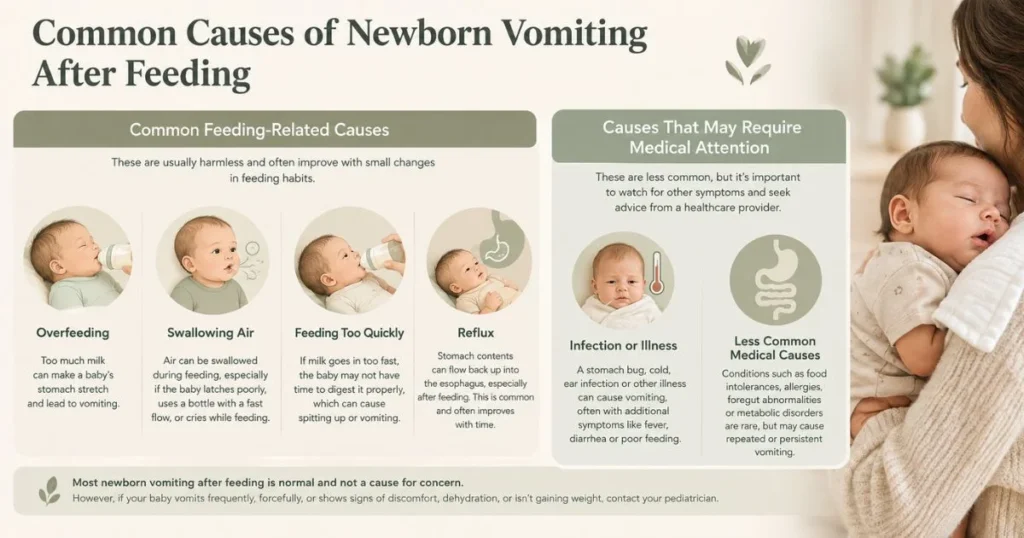
There are several possible causes. Some are common and relatively harmless, while others require medical evaluation.
Normal Gastroesophageal Reflux
For newborn baby vomiting milk after feeding, normal gastroesophageal reflux is a common reason milk may come back up after a feed.
In young infants, the muscle that helps keep stomach contents in place is still developing. Because of this, a small amount of milk can flow back into the esophagus and eventually come out through the mouth.
AAP guidance notes that infant GER may begin around 2–3 weeks of age, become more noticeable around 4–5 months, and generally improve as the baby gets older.
A baby with uncomplicated reflux may:
- Spit up during or shortly after feeds
- Remain comfortable
- Continue feeding normally
- Continue gaining weight
- Have normal wet diapers
These babies are sometimes described as “happy spitters.”
A Full Stomach or Feeding Too Quickly
With newborn baby vomiting milk after feeding, you may notice more spit-up when your baby’s stomach becomes very full or when milk enters the stomach too quickly.
With bottle feeding, a nipple with a fast flow can cause your baby to gulp milk and swallow extra air.
During breastfeeding, a strong milk flow may sometimes make feeding more challenging for a baby who is still learning to coordinate sucking, swallowing, and breathing.
Instead of assuming that every episode means your baby has been overfed, consider the overall feeding pattern.
Swallowed Air
Some With newborn baby vomiting milk after feeding, swallowing extra air during feeds may contribute to increased spit-up.
This may happen when:
- A baby has difficulty maintaining a deep latch
- The bottle flow is too fast
- The baby is crying before feeding
- Feeding is rushed
- The baby frequently breaks the latch
Burping during or after a feed may help some babies who swallow excess air. NHS guidance recommends regular burping and keeping a baby upright during and after feeds when reflux is troublesome.
If your baby also gets hiccups after feeds, you can learn more about gentle feeding, burping, and positioning strategies in our guide to How to Stop Baby Hiccups After Feeding.
Gastroesophageal Reflux Disease (GERD)
When dealing with newborn baby vomiting milk after feeding, it is important to understand that normal reflux and GERD are not the same condition.
GER is common in infants, while GERD refers to reflux that causes significant symptoms or results in complications.
Possible signs that should be discussed with your pediatrician include:
- Feeding refusal
- Significant distress during feeds
- Persistent feeding problems
- Poor weight gain
- Recurrent coughing or gagging associated with feeds
- Increasing frequency or forcefulness of spit-up
AAP recommends discussing concerning symptoms with your child’s pediatrician rather than assuming that every feeding problem is caused by reflux.
Other Causes of Vomiting in Babies and Children
Not every episode of vomiting is related to reflux.
Viral Gastroenteritis
When newborn baby vomiting milk after feeding occurs suddenly, a stomach infection may sometimes be responsible. It can occur along with:
- Diarrhea
- Fever
- Abdominal discomfort
- Reduced appetite
When a baby is vomiting, one of the main concerns is maintaining adequate hydration and monitoring for signs of dehydration.
Cow’s Milk Protein Allergy
With newborn baby vomiting milk after feeding, cow’s milk protein allergy may sometimes be considered when other gastrointestinal symptoms are also present. However, ordinary spit-up alone does not establish that a baby has an allergy.
Possible symptoms may include:
- Vomiting
- Significant feeding discomfort
- Eczema or other skin symptoms
- Diarrhea
- Blood or mucus in the stool
If you suspect a food allergy, speak with your child’s healthcare professional before eliminating foods from your diet or repeatedly changing your baby’s formula.
Food Protein-Induced Enterocolitis Syndrome (FPIES)
In cases of newborn baby vomiting milk after feeding, FPIES may be considered as a less common type of food allergy that can cause delayed, repetitive vomiting after exposure to a trigger food.
Unlike ordinary reflux, FPIES-related vomiting can be significant and may occur along with lethargy or dehydration.
Because FPIES can become serious, suspected reactions should be evaluated by a healthcare professional.
Other Causes in Older Infants and Children
When considering newborn baby vomiting milk after feeding, it is important to remember that vomiting can have different causes as children grow, including:
- Infections
- Food-related illness
- Motion sickness
- Migraine-associated vomiting
- Medication reactions
- Other gastrointestinal conditions
The most likely cause depends on the child’s age, symptoms, medical history, and events leading up to the vomiting episode.
Projectile Vomiting in a Newborn: When It Needs Attention
Newborn baby vomiting milk after feeding should not be dismissed as ordinary spit-up when the vomiting is repeated or forceful, particularly in a young infant.
One possible cause is hypertrophic pyloric stenosis, a condition in which the muscle at the outlet of the stomach becomes abnormally thickened.
It typically develops during early infancy. The vomiting may gradually become more forceful, and a baby may still appear hungry afterward.
Other possible signs include:
- Repeated forceful vomiting
- Poor weight gain
- Dehydration
- Fewer wet diapers
- Increasing weakness or lethargy
Projectile vomiting does not automatically mean your baby has pyloric stenosis. However, repeated forceful vomiting in a young infant requires prompt medical assessment. AAP identifies pyloric stenosis as an important cause of true vomiting in young babies.
What Can You Do When Your Baby Spits Up After Feeding?
If your baby is otherwise well and you’re dealing with ordinary spit-up, a few feeding adjustments may help.
Feed Responsively
When managing newborn baby vomiting milk after feeding, pay attention to your baby’s hunger and fullness cues rather than relying only on a set feeding schedule.
Hunger cues may include:
- Rooting
- Bringing hands to the mouth
- Opening the mouth
- Sucking movements
- Becoming more alert
Fullness cues may include:
- Turning away
- Closing the mouth
- Relaxing
- Slowing or stopping sucking
- Releasing the breast or bottle
For bottle-fed babies, avoid pressuring your baby to finish the entire bottle.
Newborns may also want to feed several times close together, especially during periods of cluster feeding; see When Do Babies Cluster Feed? Signs, Schedule & Tips for more information.
Check Bottle Flow
If you’re dealing with newborn baby vomiting milk after feeding while bottle feeding, pay attention to how quickly the milk is flowing.
A very fast flow may cause some babies to gulp, swallow extra air, or have difficulty coordinating sucking, swallowing, and breathing.
Responsive or paced bottle feeding can give your baby more opportunities to slow down and take natural pauses during the feed.
Burp During or After Feeding
When managing newborn baby vomiting milk after feeding, taking a few breaks to burp during and after feeds may help some babies.
There is no need to force a burp. If your baby remains comfortable and does not burp, this does not necessarily indicate a problem.
Keep Baby Upright While Awake
For newborn baby vomiting milk after feeding, keeping your baby upright during feeding and for a while afterward may help reduce reflux symptoms.
For babies with troublesome reflux, NHS guidance advises keeping them upright during feeds and for as long as reasonably possible afterward.
However, keeping your baby upright after feeding does not mean allowing them to sleep upright.
If your baby falls asleep, follow recommended safe-sleep guidance.
For a broader look at how feeding patterns change during the first year, see our Baby Feeding Schedule by Age: The Complete Month-by-Month Guide.
Safe Sleep for Babies With Reflux or Spit-Up
This is one of the most important safety points for parents.
Can a Baby With Reflux Sleep on Their Back?
Yes. For newborn baby vomiting milk after feeding, even babies who frequently spit up or have reflux should be placed on their backs for sleep.
AAP guidance recommends back sleeping for babies with reflux because placing an infant on the back does not increase the risk of serious choking in healthy infants.
Should You Elevate the Crib Mattress?
No.
For newborn baby vomiting milk after feeding, do not place pillows, wedges, positioners, towels, or other objects under the mattress to raise your baby’s head.
AAP warns that inclined or elevated sleep surfaces are not considered a safe treatment for reflux.
Your baby should sleep:
- On their back
- On a firm, flat, non-inclined surface
- In an appropriate crib, bassinet, or play yard
- Without pillows, loose blankets, positioners, or other soft objects
NHS guidance also recommends that babies with reflux sleep flat on their backs rather than on their side or front.
If you are also considering a pacifier for soothing or sleep, see our guide to Newborn Pacifier Safety: When and How to Use One.
Breastfed Baby Vomiting Milk After Feeding
With newborn baby vomiting milk after feeding, it’s important to know that breastfed babies can spit up just like formula-fed babies.
Possible contributors include:
- Fast milk flow
- Difficulty maintaining a deep latch
- Swallowed air
- Feeding very quickly
- A very full stomach
- Normal infant reflux
Don’t automatically reduce breastfeeding simply because your baby spits up.
Instead, pay attention to:
- Whether your baby is swallowing effectively
- Whether feeding is comfortable
- Wet diaper output
- Weight gain
- Your baby’s overall behavior
If you experience persistent nipple pain, difficulty with latch, or concerns about milk transfer, a lactation professional can assess the feeding directly.
If you are also trying to understand how feeding needs change as your baby grows, our Baby Feeding Chart by Age provides a simple overview from birth through the first year.
Formula-Fed Baby Vomiting After Feeding
If you’re dealing with newborn baby vomiting milk after feeding and your baby drinks formula, consider the overall feeding process rather than immediately assuming the formula itself is causing the problem.
You can discuss:
- Bottle nipple flow
- Feeding pace
- Burping
- Hunger and fullness cues
- Whether feeds are appropriately sized
Avoid repeatedly switching formulas without professional guidance.
If a healthcare professional recommends a special formula because of suspected cow’s milk protein allergy or another condition, follow the individualized feeding plan provided.
When preparing formula, always follow the product instructions for the correct amounts of water and powder. CDC guidance warns that using too much or too little water can create nutritional or safety concerns.
Should You Thicken Baby’s Milk for Reflux?
For newborn baby vomiting milk after feeding, a healthcare professional may sometimes recommend thickening feeds for an infant with significant reflux.
However, this is not a general home remedy for ordinary spit-up.
Avoid adding cereal or another thickening agent to your baby’s bottle on your own. Talk with your pediatrician first.
The appropriate approach depends on your baby’s age, feeding method, symptoms, and medical history.
When to Call the Doctor About Baby Vomiting
If you’re concerned about newborn baby vomiting milk after feeding, contact your pediatrician if:
- Vomiting is becoming more frequent or forceful.
- Your baby regularly refuses feeds.
- Your baby is not gaining weight appropriately.
- Feeding is consistently painful or difficult.
- Your baby has persistent coughing or choking with feeds.
- You notice fewer wet diapers than expected.
- Your baby seems unusually sleepy or weak.
- You’re worried that your baby isn’t getting enough milk.
Seek urgent medical attention if your baby:
If newborn baby vomiting milk after feeding is accompanied by any of the following warning signs, seek urgent medical attention:
- Green or yellow-green vomit
- Blood in the vomit
- Repeated projectile or forceful vomiting
- Signs of significant dehydration
- Being extremely difficult to wake
- Appearing seriously ill
- Significant abdominal swelling or severe pain
NHS guidance specifically recommends urgent assessment when a baby has projectile vomiting or vomit that is green/yellow or contains blood.
For very young infants, a sudden change from ordinary spit-up to forceful vomiting also warrants prompt medical attention.
Signs of Dehydration in a Baby
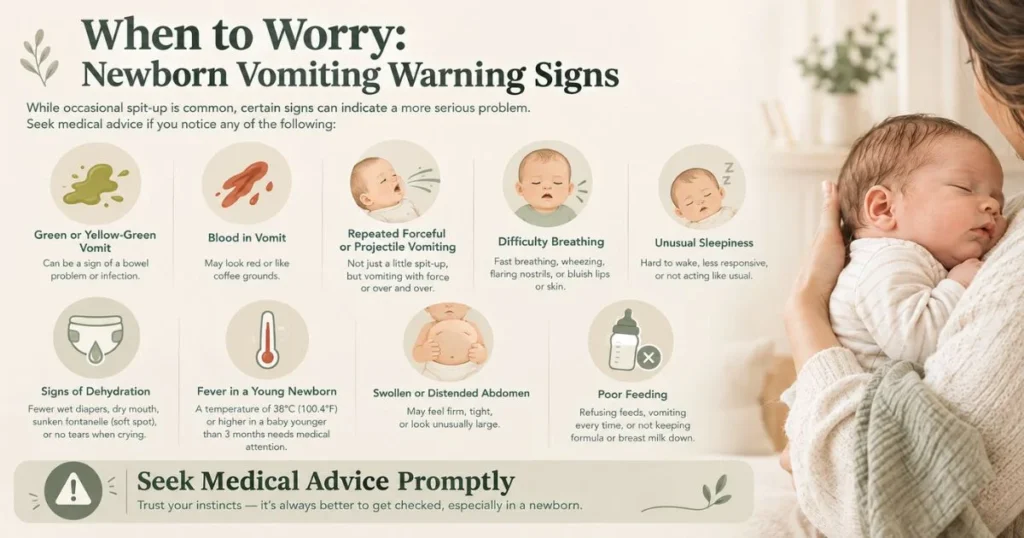
With newborn baby vomiting milk after feeding, dehydration can become a concern if your baby is losing more fluid than they are able to replace.
Possible signs of dehydration include:
- Fewer wet diapers
- A dry mouth
- Poor feeding
- Unusual sleepiness
- Weakness
- Fewer tears than expected when your child normally produces them
For newborns, the expected number of wet diapers changes during the first few days of life. For this reason, diaper counts should be considered alongside your baby’s age and feeding history rather than used on their own.
If you are concerned that your newborn may be dehydrated, contact your baby’s healthcare professional promptly.
What Should I Give My Baby After Vomiting?
The right response depends on your baby’s age and feeding method.
Breastfed Babies
For newborn baby vomiting milk after feeding, breast milk should generally remain your young breastfed baby’s main source of nutrition and hydration.
If vomiting happens repeatedly or your baby cannot keep feeds down, contact your pediatrician rather than replacing breast milk with water.
Formula-Fed Babies
For newborn baby vomiting milk after feeding, continue following your baby’s usual feeding plan unless your healthcare professional recommends a different approach.
Do not dilute formula or add extra water in an attempt to make it easier for your baby to tolerate. Incorrect formula preparation can reduce its nutritional content or create potential health risks.
Older Infants and Children
For newborn baby vomiting milk after feeding, the appropriate approach to replacing fluids depends on your baby’s age and individual circumstances.
For older babies and children who have repeated vomiting, a healthcare professional may recommend offering small, frequent amounts of fluid or an appropriate oral rehydration solution.
The recommended approach depends on the child’s age, symptoms, feeding situation, and degree of dehydration.
What Not to Do When Your Baby Vomits
When dealing with newborn baby vomiting milk after feeding, avoid trying several treatments or changes at the same time.
Do not:
- Put your baby to sleep on their stomach because of reflux.
- Use side sleeping as a way to manage reflux.
- Elevate the crib mattress.
- Use sleep positioners or reflux wedges.
- Give medication for vomiting without medical advice.
- Give a young infant water instead of breast milk or formula.
- Change formula repeatedly without professional guidance.
- Add cereal to bottles unless directed by a healthcare professional.
- Restrict feeds simply because your baby spits up.
Even babies with reflux should be placed on their backs to sleep on a firm, flat surface as part of recommended safe-sleep practices.
Infant Vomiting vs. Reflux vs. GERD: Quick Comparison
| Condition | What it may look like | What parents should know |
| Normal spit-up / GER | Gentle milk coming back up | Very common in infancy |
| GERD | Reflux with troublesome symptoms or complications | Discuss with your pediatrician |
| Vomiting | More forceful expulsion of stomach contents | Look for the underlying cause |
| Gastroenteritis | Vomiting often with diarrhea or fever | Hydration is important |
| Pyloric stenosis | Repeated forceful vomiting in a young infant | Requires prompt medical evaluation |
| FPIES | Delayed repetitive vomiting after a trigger food | Requires medical assessment |
Frequently Asked Questions
Is it normal for a newborn to vomit milk after feeding?
With newborn baby vomiting milk after feeding, it can be normal for a newborn to bring up a small amount of milk without much effort, which is generally considered spit-up. Forceful vomiting is different from ordinary spit-up and should be assessed based on your baby’s age, other symptoms, feeding, hydration, and growth.
Why does my baby throw up milk after every feeding?
With newborn baby vomiting milk after feeding, frequent spit-up can be a normal part of infant reflux, particularly during the early months. However, if the vomiting becomes forceful, your baby seems uncomfortable, refuses feeds, is not gaining weight as expected, or develops other symptoms, contact your pediatrician for guidance.
What is the difference between spit-up and vomiting?
With newborn baby vomiting milk after feeding, it can help to distinguish normal spit-up from true vomiting. Spit-up usually comes up gently and may occur when your baby burps. Vomiting is typically more forceful and involves stronger muscle contractions that push stomach contents out.
Why does my baby’s spit-up look curdled?
Milk can look thicker or curdled after mixing with stomach contents. The appearance by itself does not indicate that something is wrong.
Can reflux cause a baby to vomit?
Reflux commonly causes effortless spit-up. More forceful vomiting can have other causes, so repeated vomiting should not automatically be labeled reflux.
Can babies with reflux safely sleep on their backs?
Yes. Babies with reflux should still be placed on their backs for sleep on a firm, flat surface. Back sleeping does not increase serious choking risk in healthy infants with reflux.
Should I keep my baby upright after feeding?
For newborn baby vomiting milk after feeding, keeping your baby upright while awake after a feed may help ease reflux symptoms. NHS guidance recommends holding babies upright during feeds and for as long as reasonably possible afterward when reflux is troublesome.
When is projectile vomiting dangerous?
Repeated forceful or projectile vomiting in a young infant needs prompt medical evaluation. One possible cause is hypertrophic pyloric stenosis.
What does green vomit mean in a baby?
Green-colored vomit may contain bile and should be evaluated by a medical professional urgently. Do not assume it is ordinary reflux.
What should I give my baby after vomiting?
For newborn baby vomiting milk after feeding, young infants should not be given water as a substitute for breast milk or formula. If vomiting occurs repeatedly or your baby cannot keep feeds down, contact your healthcare professional for individualized guidance.
Can you overfeed a baby?
A baby may spit up more when their stomach becomes very full, but spit-up alone does not prove overfeeding. Follow hunger and fullness cues and discuss feeding amounts with your pediatrician if you’re concerned.
When should you contact a doctor about your baby’s vomiting?
Contact your pediatrician for persistent or worsening vomiting, feeding difficulties, poor weight gain, dehydration concerns, or significant discomfort. Seek urgent medical attention for green or bloody vomit, repeated projectile vomiting, severe lethargy, or other signs of serious illness.
Final Takeaway

Seeing milk come back up after a feeding can look much more serious than it actually is.
For many newborns, small, effortless spit-up is a normal part of early digestion. Reflux is common, and most babies gradually outgrow it as their digestive system matures.
The important distinction is between ordinary spit-up and true vomiting.
Pay particular attention to:
- How forcefully your baby vomits
- How often it happens
- Whether your baby feeds well
- Wet diaper output
- Weight gain
- Your baby’s energy and behavior
- The color or presence of blood in the vomit
Green or bloody vomit, repeated projectile vomiting, dehydration, significant lethargy, or a baby who appears seriously ill should never be dismissed as ordinary reflux.
Parenting Whisper Reminder
You don’t need to panic over every little spit-up. But you also don’t have to ignore your instincts when something looks different from your baby’s usual pattern.
When in doubt, especially with a newborn, it’s always reasonable to contact your baby’s healthcare professional and explain exactly what you’re seeing.