

When do babies cluster feed? Your newborn may feed, seem satisfied for a little while, and then want to eat again. Then again. And again.
If this happens mostly during certain parts of the day—especially the late afternoon or evening—you may be wondering whether something is wrong.
Often, what you’re seeing is cluster feeding in newborns: a normal pattern in which a baby wants to feed repeatedly over a relatively short period rather than following a predictable feeding interval.
Cluster feeding can be exhausting, especially during those early weeks when you’re already recovering from birth and learning your baby’s cues. But frequent feeding does not automatically mean your baby isn’t getting enough milk or that your milk supply is too low.
The more useful question is whether your baby is feeding effectively, producing enough wet diapers, gaining appropriately, and otherwise doing well.
This guide explains what cluster feeding looks like, when it commonly happens, how long it can last, what a flexible feeding pattern may look like, and when frequent feeding deserves a closer look.
Medical note: This article is for general education and does not replace individualized advice from your baby’s pediatrician, midwife, or lactation professional. Babies born prematurely or with medical conditions may need a different feeding plan.
What Is Cluster Feeding?
Cluster feeding is a pattern in which a baby wants to feed several times within a relatively short period. If you’re wondering when do babies cluster feed, this pattern is especially common during the newborn period and may occur at different times throughout the day.
Instead of feeding and then waiting several hours before the next feed, your newborn may:
- Feed
- Take a short break
- Show hunger cues again
- Feed again
- Rest briefly
- Want to feed again
The pattern can continue for several hours and may happen during the day, at night, or at different times from one day to the next.
There is no single definition that says a baby must feed every 30 minutes, every hour, or for a particular number of minutes to qualify as cluster feeding. Babies have different feeding styles, and even the same baby may feed differently from one day to another.
The NHS describes cluster feeding as a period when a baby wants to feed much more frequently, sometimes almost constantly, and notes that it commonly occurs during the first three to four months.
For most healthy, full-term newborns, responsive feeding is more useful than watching the clock. The American Academy of Pediatrics recommends looking for hunger cues and feeding when your baby appears hungry rather than expecting every baby to follow exactly the same schedule.

“If you’re also trying to understand your baby’s overall feeding pattern, a baby feeding schedule by age can help you see how feeding needs change as your baby grows.”
Does Cluster Feeding Mean Low Milk Supply?
Not necessarily.
If you’re wondering when do babies cluster feed, remember that frequent nursing does not automatically mean there is a problem with milk supply. A newborn may feed often simply because newborns naturally need frequent feeds. Breastfed newborns commonly feed 8 to 12 times in 24 hours, and some babies may want to nurse much more frequently during particular periods.
Cluster feeding can also occur while breastfeeding is becoming established because frequent milk removal helps signal the body to continue producing milk.
So if your newborn suddenly wants to nurse repeatedly in the evening, try not to assume immediately that your body isn’t making enough milk.
Instead, look at the whole picture: swallowing, diapers, weight gain, latch, and your baby’s overall condition.
When Do Babies Cluster Feed?
When do babies cluster feed? Cluster feeding can occur at different stages of early infancy, but it is especially common during the newborn period and first few months.
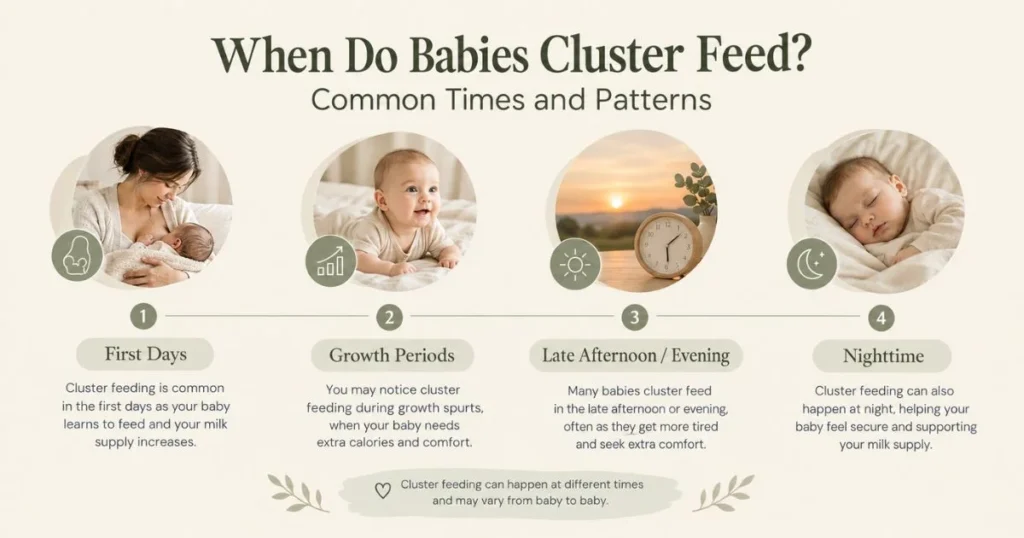
During the First Days After Birth
The first days can involve very frequent feeding, which is one reason you may wonder when do babies cluster feed during this early stage.
Your newborn’s stomach is small, and feeding frequently is part of normal newborn feeding behavior. Breastfed newborns generally nurse around 8–12 times in 24 hours, although individual babies may feed more or less frequently at particular times.
During the first days, you’re also moving through the transition from colostrum toward a larger milk supply.
Rather than expecting perfectly spaced feeds, focus on your baby’s feeding cues and whether feeding appears effective.
During the first days, frequent feeding is normal, and learning about first foods for baby can help you understand what changes once your baby is ready for complementary foods.
During Periods of Increased Growth
Some babies temporarily want to feed much more often when they are going through a period of rapid growth. This is one situation that can help explain when do babies cluster feed more frequently for a short time.
The NHS notes that babies may cluster feed for a few days during a growth spurt.
You don’t need to memorize a list of exact “growth-spurt days.” Babies don’t all follow the same developmental calendar.
A sudden increase in feeding for a few days can happen without meaning that something is wrong.
In the Late Afternoon or Evening
Many parents notice cluster feeding in the evening, which is a common time to wonder when do babies cluster feed and why babies may want several feeds close together.
Your baby may seem to feed normally during the morning and early afternoon and then suddenly want repeated feeds later in the day.
This can overlap with the period parents often call the witching hour.
However, witching-hour fussiness and cluster feeding aren’t identical.
A baby experiencing cluster feeding is actively seeking repeated feeds. A baby experiencing witching-hour fussiness may be crying or unsettled without actually being hungry.
At Night
When do babies cluster feed? Cluster feeding doesn’t have to happen in the evening.
Some babies may cluster feed at night, while others have periods of frequent feeding at different points throughout the day.
That’s why it’s better to think of cluster feeding as a feeding pattern, rather than a specific time of day.
What Causes Cluster Feeding?

If you’re wondering when do babies cluster feed, there isn’t always one single reason babies cluster feed. Several normal factors may contribute to this feeding pattern.
1. Newborns Naturally Feed Frequently
If you’re wondering when do babies cluster feed, remember that newborns are not expected to follow the same eating pattern as older babies, which is why newborn cluster feeding can be part of normal early feeding behavior.
Their feeding needs are frequent, and their feeding intervals can vary considerably.
The AAP notes that some babies prefer smaller, more frequent feeds while others take more at once and go longer between feeds.
2. Frequent Feeding Supports Milk Production
For breastfeeding parents, milk production responds in part to milk removal.
When a baby nurses effectively, the body receives signals involved in continuing milk production. The CDC notes that newborns commonly breastfeed 8–12 times per day and that frequent breastfeeding is part of establishing and maintaining milk production.
Understanding when do babies cluster feed can help explain why frequent feeding in newborns does not automatically mean your milk supply is inadequate or why babies may cluster feed at certain times.
3. Temporary Increases in Appetite
Babies sometimes have periods when they appear hungrier and want to feed more frequently. This can be one reason babies cluster feed during growth spurts, and these periods are often temporary.
Your baby may return to a more familiar feeding pattern after several days.
4. Comfort and Regulation
Babies don’t suck only because they’re hungry.
Sucking can also be soothing, and newborns often seek closeness, warmth, and physical contact. This can sometimes happen alongside newborn cluster feeding, making it harder for new parents to know whether their baby wants nutrition, comfort, or both.
The AAP points out that babies may suck for comfort as well as nutrition, which can sometimes make it difficult for new parents to tell exactly what their baby needs.
That doesn’t mean you should ignore hunger cues. Instead, look at several cues together.
Signs of Cluster Feeding
You may be seeing cluster feeding if your baby repeatedly wants to feed over a relatively short period. These patterns can help you recognize when babies cluster feed and distinguish frequent feeding from a more typical feeding routine.
Common patterns include:
- Your baby wants to feed again soon after a previous feed.
- Several feeds happen close together.
- The pattern is more noticeable at a particular time of day.
- Your baby actively sucks and swallows during feeds.
- Your baby feeds, takes a short break, and then shows hunger cues again.
- Your baby may become fussy when a feed ends.
- The pattern may continue for several hours and then settle.
Remember that feeding frequency alone doesn’t tell you whether your baby is getting enough milk.
What Are the Signs of Hunger?
When babies cluster feed, recognizing early hunger cues can help you respond before your newborn becomes very upset.
Early hunger cues can include:
- Rooting
- Opening the mouth
- Licking or smacking the lips
- Bringing hands toward the mouth
- Becoming more alert
- Sucking on hands
- Increasing movement or fussiness
Crying is generally a later hunger cue.
What Are the Signs Your Baby Is Full?
During cluster feeding, your baby may still show clear signs that they have had enough.
Your baby may:
- Slow down or stop sucking
- Turn away from the breast or bottle
- Relax their hands and body
- Become distracted
- Fall asleep after feeding
AAP guidance emphasizes following these individual hunger and fullness cues rather than trying to make every baby consume a predetermined amount.
Cluster Feeding vs. Witching Hour, Gas, and Colic
Frequent feeding can sometimes be confused with other reasons a newborn may be unsettled.
| Pattern | What you may notice |
| Cluster feeding | Baby repeatedly seeks feeds over a relatively short period |
| Witching-hour fussiness | Baby becomes unusually fussy or cries, often later in the day |
| Gas discomfort | Baby may squirm, draw up their legs, or seem uncomfortable |
| Colic | Recurrent episodes of prolonged crying in an otherwise healthy infant |
| Hunger | Baby shows recognizable hunger cues and actively feeds |
These patterns can also overlap, especially during newborn cluster feeding.
For example, a baby can be both hungry and fussy.
Likewise, a newborn may want to suck for comfort after feeding without actually needing another full feed.
Instead of trying to diagnose the reason from one behavior, look at what happens during the feed and how your baby behaves afterward.
If your baby’s crying seems unusual, persistent, or difficult to soothe, talk with your pediatrician.
How Long Does Cluster Feeding Last?
This is one of the most common questions parents ask about how long babies cluster feed.
The honest answer is: there isn’t one exact duration that applies to every baby.
How Long Can One Cluster Feeding Period Last?
A cluster-feeding period may continue for several hours, depending on the baby and the situation.
Some babies have a relatively short period of frequent feeding, while others may feed repeatedly for much of the evening.
Don’t worry if your baby’s pattern doesn’t match an online example exactly. There is no single schedule that every baby follows.
How Many Days Does Cluster Feeding Last?
A temporary period of increased feeding may last several days, particularly when cluster feeding occurs during a growth spurt.
The NHS notes that cluster feeding can happen for a few days during growth spurts.
If your baby is otherwise feeding effectively and growing appropriately, a few days of increased feeding does not automatically signal a problem.
When Does Newborn Cluster Feeding Stop?
Cluster feeding often becomes less intense or less frequent as babies mature, but there is no universal age when it must stop.
The NHS notes that cluster feeding commonly occurs during the first three to four months.
Some babies become more predictable earlier, while others continue to have periods of frequent feeding.
Cluster Feeding Schedule: What Can a Newborn’s Day Look Like?

If you’re wondering when do babies cluster feed, there is no single cluster feeding schedule that every newborn should follow.
For a healthy, full-term newborn, responsive feeding is generally more appropriate than trying to fit feeds into fixed times on the clock. The AAP recommends responding to hunger cues while recognizing that each baby can have their own feeding pattern.
A Flexible Breastfed Newborn Example
A day might look something like this:
Morning:
Baby feeds after waking and may feed again within a few hours.
Late morning:
Another feed based on hunger cues.
Afternoon:
Feeds continue according to your baby’s needs.
Late afternoon:
Your baby begins wanting feeds closer together.
Evening:
Several feeds may occur within a few hours, with short periods of rest between them.
Overnight:
Your baby continues to wake and feed according to their individual needs.
This is an example of a rhythm, not a schedule to enforce.
Your baby might cluster feed at 5 PM one evening and 7 PM the next.
What About Formula-Fed Babies?
When do babies cluster feed if they are formula-fed? Formula-fed babies can also cluster feed, particularly during the first few months.
The NHS specifically notes that formula-fed babies may cluster feed during this period.
However, bottle feeding requires particular attention to fullness cues because milk can flow more easily and quickly from a bottle.
Rather than automatically offering another full bottle whenever your baby fusses, first look for hunger cues.
If your baby is hungry, feed them.
If they are showing fullness cues, allow them to stop.
AAP guidance recommends responsive bottle feeding and watching for signs such as turning away, releasing the nipple, slowing sucking, or falling asleep.
“Whether your baby breastfeeds or takes formula, responsive feeding is important, and your baby feeding chart can provide a broader look at feeding patterns as your baby grows.”
Can You Overfeed a Cluster-Feeding Baby?
This depends partly on how your baby is fed.
Breastfed Babies
When do babies cluster feed, and does frequent nursing mean they are getting too much milk? Not necessarily. Frequent breastfeeding does not automatically mean your baby is taking in too much milk.
A breastfed newborn may nurse many times throughout the day, including during a cluster-feeding period.
Rather than counting minutes or trying to restrict the number of feeds, pay attention to effective feeding, swallowing, diaper output, weight gain, and your baby’s hunger and fullness cues.
Bottle-Fed Babies
When considering when do babies cluster feed, remember that bottle-fed babies can also have periods of frequent feeding and should still be fed responsively.
Watch for signs that your baby has had enough, such as:
- Turning the head away
- Releasing the nipple
- Slowing or stopping sucking
- Relaxing
- Falling asleep
You don’t need to make your baby finish a bottle.
AAP guidance notes that bottle-fed babies may be more likely to take more than they need if feeding is not responsive, so watching fullness cues is important.
Does Cluster Feeding Mean Your Baby Isn’t Getting Enough Milk?
This is probably the biggest worry behind the question, “When do babies cluster feed, and does frequent feeding mean my baby isn’t getting enough?”
Not necessarily.
A newborn can feed very frequently and still be getting enough.
Instead of using feeding frequency alone to judge milk intake, look for several signs that feeding is going well.
Signs Your Breastfed Newborn May Be Getting Enough
When you’re learning when babies cluster feed, it’s helpful to know which signs suggest that your baby is feeding effectively.
The CDC lists several reassuring signs, including:
- Breastfeeding around 8–12 times in 24 hours
- Seeing or hearing swallowing
- Baby appearing content after feeds
- Appropriate weight gain
- Adequate wet and dirty diapers
A baby’s weight is particularly important because it provides objective information about growth.
Your baby’s healthcare provider can monitor their weight and determine whether the feeding pattern is supporting healthy growth.
What If Your Baby Seems Hungry All the Time?
If you’re trying to understand when babies cluster feed versus when frequent feeding may signal a concern, look at how your baby is feeding overall.
If your baby is repeatedly feeding but:
- rarely seems satisfied,
- struggles to latch,
- you don’t hear swallowing,
- has too few wet diapers,
- continues losing weight,
- or seems unusually sleepy,
it’s worth getting feeding support rather than assuming it’s simply cluster feeding.
Newborn Wet Diapers: A Helpful Feeding Check
Diaper output can provide useful information during the first week.
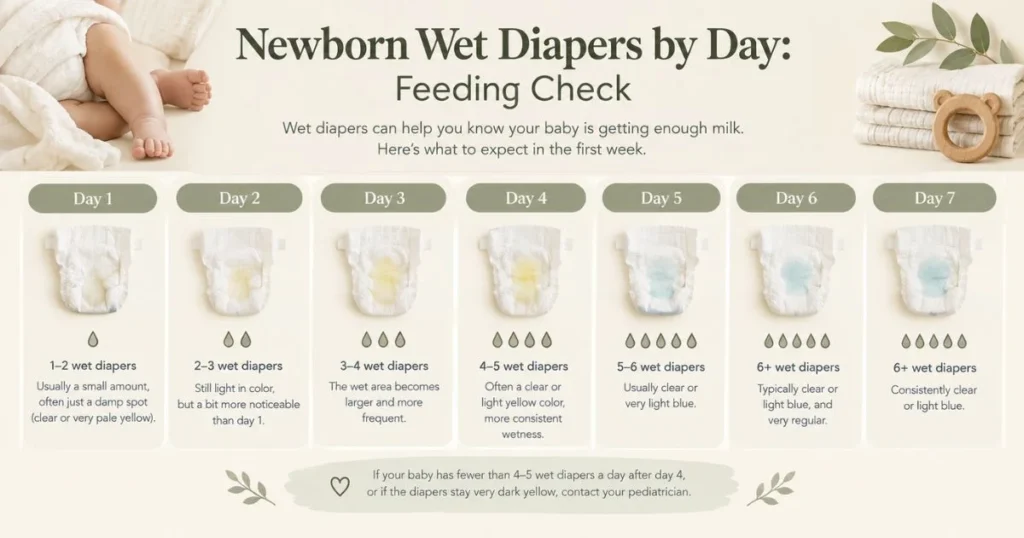
CDC gives the following minimum wet-diaper benchmarks for breastfed newborns:
| Baby’s age | Minimum wet diapers in 24 hours |
| Day 1 | 1 |
| Day 2 | 2 |
| Day 3 | 5 |
| Day 4 | 6 |
| Days 5–7 | 6 |
Stool patterns also change during the first week as your baby moves from meconium to transitional stools and eventually yellow stools.
After the first week, stool frequency can vary considerably from one baby to another, especially as babies get older. This is important to remember when considering when do babies cluster feed, because diaper patterns should be viewed alongside other signs of effective feeding.
Diapers are only one part of the overall assessment.
Your pediatrician may also consider your baby’s weight, feeding effectiveness, hydration, swallowing, and overall health when determining whether frequent feeding is part of a normal pattern or needs further evaluation.
How to Make Cluster Feeding Easier
Cluster feeding can take a lot out of you. If you’re wondering when do babies cluster feed, remember that it often happens during certain parts of the day, especially in the evening.
You don’t need to make the evening perfect. Your goal is simply to make it more manageable.

Create a Feeding Station
Before the period when your baby usually becomes hungry, especially if you’re wondering when do babies cluster feed, keep nearby:
- A large water bottle
- Easy snacks
- Burp cloths
- Diapers
- Your phone charger
- A comfortable pillow
- Something to watch or listen to
If you’re breastfeeding, having everything within reach can make repeated feeds feel much less disruptive.
Rest Before the Cluster-Feeding Period
If you’re wondering when do babies cluster feed, you may notice that your baby tends to cluster feed in the evening. Use an earlier quiet period to rest when possible.
You don’t have to finish every household task before sitting down.
Some days, the dishes can wait.
Let Someone Else Handle the Non-Feeding Tasks
When you’re learning when do babies cluster feed, having support can make frequent feeding periods much easier to manage.
A partner, relative, or trusted support person can:
- Bring you food and water
- Change diapers
- Burp the baby
- Prepare meals
- Wash bottles
- Handle household chores
- Care for older children
You are still being productive when you’re feeding your newborn.
Use Skin-to-Skin Contact
Understanding when do babies cluster feed can help you recognize when your newborn may simply need frequent feeding, while skin-to-skin contact can be a comforting way to stay close to your baby and support bonding.
It doesn’t mean you need to stop feeding when your baby is hungry.
Think of it as another tool for moments when your newborn wants warmth, closeness, and reassurance.
Take Care of Your Body
Knowing when do babies cluster feed can help you plan ahead and make sure you have enough time to care for yourself during frequent feeding periods.
Eat regular meals when you can.
Drink when you’re thirsty.
Change positions if you’re uncomfortable.
And if breastfeeding is painful, don’t assume that pain is simply something you have to tolerate.
Persistent nipple pain or difficulty with latch is a good reason to seek lactation support.
What About Pacifiers During Cluster Feeding?
Understanding when do babies cluster feed can help you tell the difference between normal frequent feeding and times when your baby may simply want to suck for comfort.
Pacifiers can be useful for some babies, particularly when they want to suck for comfort rather than nutrition.
But don’t use a pacifier to routinely delay a newborn who is showing clear hunger cues.
For breastfeeding families, the AAP notes that parents may wish to wait until breastfeeding is well established before introducing a pacifier, generally around 3 to 4 weeks for healthy, full-term babies. Individual circumstances can differ.
If your baby is hungry, feed your baby.
If your baby has recently fed effectively and is showing signs of wanting to suck for comfort, a pacifier may be one option.
If you’re considering a pacifier for your newborn, you may also want to review our guide to newborn pacifier safety.
Cluster Feeding and Power Pumping: Do You Need to Pump?
If you’re wondering when do babies cluster feed, you may also come across power pumping schedules when searching for information about cluster feeding.
Power pumping is a pumping strategy sometimes used by breastfeeding parents who want to stimulate additional milk expression.
But cluster feeding your baby does not automatically mean you need to start power pumping.
If you are concerned about low milk supply, it is better to first assess:
- Baby’s latch
- Milk transfer
- Feeding frequency
- Swallowing
- Diaper output
- Weight gain
- Pumping technique, if you pump
A lactation consultant or healthcare professional can help determine whether additional pumping is appropriate for your situation.
Don’t assume that every period of frequent feeding means your body needs extra pumping.
When Should You Talk to Your Pediatrician or Lactation Consultant?
If you’re wondering when do babies cluster feed, remember that cluster feeding itself is usually not a problem.
Frequent feeding becomes a concern when it is accompanied by signs that your baby may not be feeding well or receiving enough milk.
Contact your baby’s healthcare professional if:
- Your baby is difficult to wake for feeds.
- Your baby is not latching effectively.
- You rarely see or hear swallowing during breastfeeding.
- Your baby repeatedly slips off the breast.
- Feeding is consistently painful.
- Your baby has fewer wet diapers than expected.
- Your baby keeps losing weight beyond the initial newborn period.
- Your baby is not gaining weight appropriately.
- Your baby remains unusually lethargic.
- Your baby seems persistently distressed after feeds.
- You’re worried that your baby may not be taking in enough milk or that your milk production may be insufficient.
According to the CDC, signs that a breastfed newborn may not be receiving enough milk include nursing fewer than eight times a day, difficulty maintaining a latch, little or no audible swallowing, ongoing weight loss after day five, and fewer than six wet diapers per day by the fifth day of life.
If you’re worried, you don’t need to wait until the situation becomes severe before asking for help.
A lactation consultant can observe a feeding and help determine whether your baby is transferring milk effectively.
Cluster Feeding in Newborns: FAQs
What is cluster feeding in newborns?
When do babies cluster feed? Cluster feeding is a pattern in which a baby wants to feed repeatedly over a relatively short period. It is particularly common during the early months and may happen during the day or night.
When do babies cluster feed?
Knowing when do babies cluster feed can help you understand that babies may cluster feed during the newborn period, during temporary periods of increased appetite, and around growth spurts. Many parents notice the pattern in the late afternoon or evening, but it can happen at other times too.
How long does cluster feeding last?
Understanding when do babies cluster feed can help you know what to expect. A single period may last several hours, while a temporary phase of increased feeding can continue for several days. Every baby is different, so there is no set amount of time that applies to all infants.
Do formula-fed babies cluster feed?
If you’re wondering when do babies cluster feed, it’s important to know that this pattern is not limited to breastfeeding. Yes, formula-fed babies can also have periods when they want to feed more frequently. The NHS notes that cluster feeding can occur in formula-fed babies as well.
Could Cluster Feeding Mean Your Milk Supply Is Low?
If you’re wondering when do babies cluster feed, remember that frequent nursing does not always mean there is a problem with milk supply. Nursing often is typical for newborns and can be a normal part of the breastfeeding process. Instead of judging milk supply by how often your baby feeds, pay attention to effective feeding, audible swallowing, wet diapers, and healthy weight gain.
Can you overfeed a cluster-feeding baby?
Understanding when do babies cluster feed can also help you recognize that responsive feeding helps babies regulate how much they take. With bottle feeding, watch for fullness cues and don’t pressure your baby to finish a bottle.
Does cluster feeding happen at night?
When do babies cluster feed? Cluster feeding can occur during the day, at night, or at different times depending on the baby.
If frequent nighttime feeding is affecting your baby’s sleep, you may also find our guide to baby sleep schedules by age helpful.
Will my baby sleep longer after cluster feeding?
Knowing when do babies cluster feed can help set realistic expectations about your baby’s sleep. Some babies may sleep for a longer period after a stretch of frequent feeding, but cluster feeding does not guarantee a longer stretch of sleep.
Newborns still need frequent feeds, and sleep patterns vary widely.
Cluster feeding does not guarantee longer sleep, so understanding a newborn sleep schedule can help you set realistic expectations during the first few months.
Should You Put a Newborn on a Strict Feeding Schedule?
Understanding when do babies cluster feed can help you recognize your baby’s feeding patterns. For most healthy, full-term newborns, responsive feeding is generally preferred over forcing a rigid clock-based schedule. Watch for hunger cues and follow your baby’s needs.
Babies born prematurely or with certain medical conditions may need a feeding schedule recommended by their healthcare provider.
When should I worry about cluster feeding?
Knowing when do babies cluster feed can help you recognize normal feeding patterns, but talk with your baby’s healthcare professional if frequent feeding is accompanied by poor latch, little or no swallowing, inadequate wet diapers, continued weight loss, poor weight gain, unusual sleepiness, or persistent feeding difficulties.
The Bottom Line
When do babies cluster feed? Cluster feeding in newborns can look intense, but frequent feeding doesn’t automatically mean something is wrong.
Your baby may simply be going through a period of increased feeding, particularly during the early weeks or around a temporary growth period.
Instead of trying to make your newborn follow a perfect schedule, look at the bigger picture:
- Is your baby feeding effectively?
- Are you seeing or hearing swallowing?
- Are wet diapers increasing appropriately?
- Is your baby gaining weight?
- Does your baby appear well between feeds?
If the answer is generally yes, a few exhausting evenings of frequent feeding may simply be part of your baby’s normal pattern.
And if something doesn’t feel right, you don’t have to figure it out alone. Your pediatrician or a qualified lactation professional can help you determine whether your baby’s feeding pattern is working well.
Parenting Whisper Reminder
Your baby’s feeding pattern doesn’t have to look like anyone else’s.
Some days will feel beautifully predictable. Other days may seem like one long cycle of feeding, burping, changing, and feeding again.
You’re not doing anything wrong when your newborn wants to feed again soon after the last feeding.
You’re learning your baby—and that’s a process, not a perfect schedule.