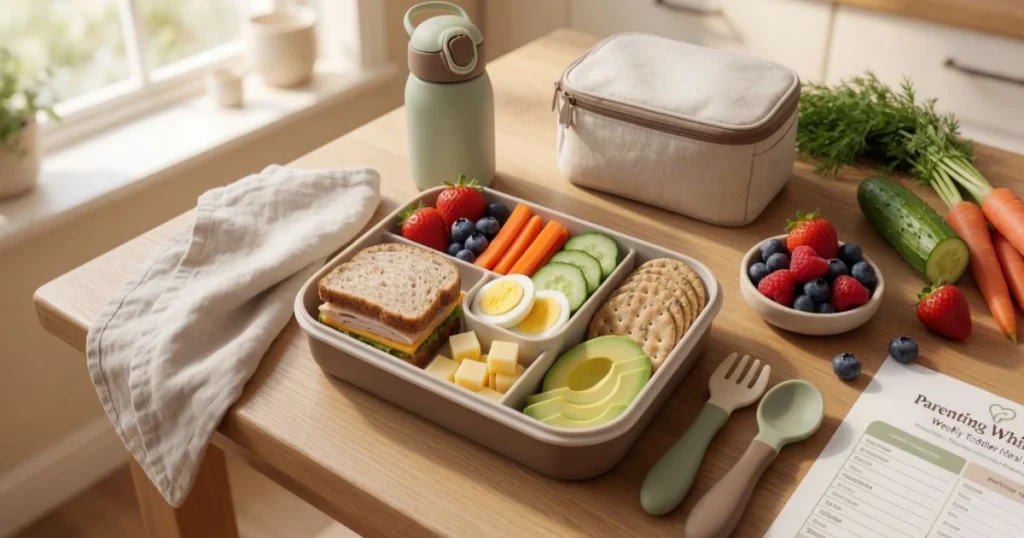
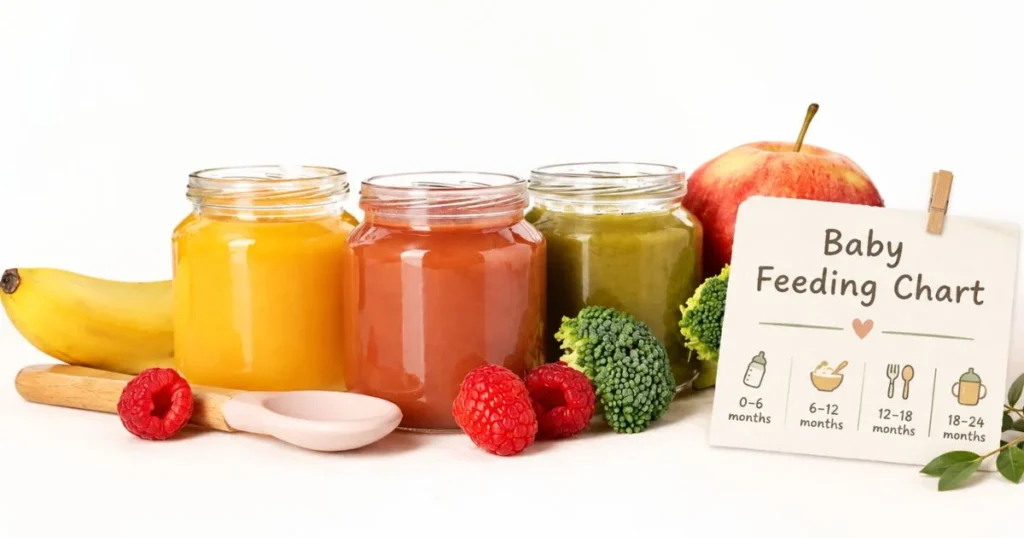
If you are trying to figure out how often your baby should eat, how much milk they need, when to introduce solids, and when meals start becoming more regular, the Baby Feeding Chart can give you a helpful starting point.
But think of the Baby Feeding Chart as a road map, not a stopwatch.
Babies do not all eat the same amount or follow the same schedule. Breastfed babies may feed more frequently than formula-fed babies, and appetite can change from one day to the next. As your baby grows, feeding gradually changes from frequent milk feeds toward a combination of milk, solid foods, and eventually family meals.
During the first year, breast milk and/or infant formula remains the main source of nutrition. Around 6 months, complementary foods are introduced when your baby is developmentally ready, and those foods gradually become a larger part of the diet.
This Baby Feeding Chart by age covers the journey from newborn feeding through 24 months, including example schedules, milk, solids, water, hunger cues, and the transition to toddler meals.

Important: The schedules and amounts below are general examples, not medical prescriptions. Premature babies, babies with growth concerns, feeding difficulties, allergies, or medical conditions may need an individualized plan from their pediatrician.
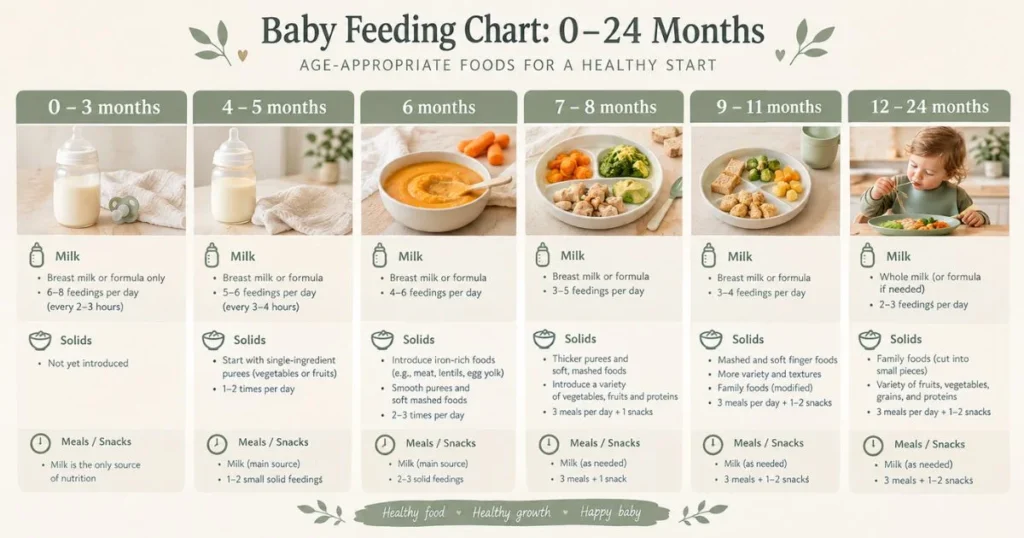
Baby Feeding Chart: 0–24 Months
| Age | Main Nutrition | Solid Foods | Typical Rhythm | Water |
| 0–1 month | Breast milk and/or formula | None unless medically advised | Frequent responsive feeds | Not needed as a routine drink |
| 1–3 months | Breast milk and/or formula | None | Regular milk feeds based on cues | Not needed as a routine drink |
| 4–5 months | Breast milk and/or formula | Usually not yet | Continue milk feeds | Not needed as a routine drink |
| Around 6 months | Breast milk/formula + solids | Begin when developmentally ready | Milk plus gradually increasing meals | Small amounts can be offered |
| 7–8 months | Breast milk/formula + solids | More regular meals | Milk + meals | Offer with meals |
| 9–11 months | Breast milk/formula + solids | Regular meals and self-feeding | Milk + meals + snacks as appropriate | Offer regularly |
| 12–24 months | Varied foods + milk/breastfeeding | Family-style meals | 3 meals + 2–3 snacks as appropriate | Water regularly |
The exact timing will vary. CDC recommends establishing regular meal and snack times while continuing to pay attention to your child’s hunger and fullness signals.
Newborn Feeding Schedule: 0–1 Month
Newborns have very small stomachs, so they typically need to feed frequently. In the Baby Feeding Chart, this stage should be viewed as a flexible guide rather than a strict, clock-based routine. Instead, feed your baby responsively and look for early signs of hunger.
Breastfeeding a newborn
During the first days and weeks, a breastfed newborn may want to eat as often as every 1–3 hours. As feeding becomes established, exclusively breastfed babies commonly feed around 8–12 times in 24 hours. The Baby Feeding Chart can help you understand these typical feeding patterns while leaving room for individual differences.
Some babies may feed even more frequently for short periods. Cluster feeding can be normal, particularly at certain times of day or during developmental changes.
Rather than trying to measure ounces of breast milk, pay attention to your baby’s feeding behavior, diaper output, alertness, and growth.
If your newborn is unusually sleepy and difficult to wake for feeds, or you are concerned that they are not feeding well, contact your baby’s doctor or nurse.
Formula feeding a newborn
For a newborn who is fed only infant formula, the CDC recommends starting with about 1–2 ounces every 2–3 hours during the first days, with additional formula offered when the baby shows hunger cues. Most formula-fed newborns feed about 8–12 times within 24 hours during this early stage. This Baby Feeding Chart can help you understand how feeding amounts and frequency may change during the newborn period.
As your baby grows, they typically take larger amounts at each feeding and may gradually go longer between feeds.
During the first few weeks and months, many formula-fed infants feed approximately every 3–4 hours.
What about feeding overnight?
Newborns generally need regular feeds throughout both the day and night. In the Baby Feeding Chart, nighttime feeding should remain flexible because babies have different sleep and hunger patterns.
Some babies naturally wake when they are hungry, while sleepy newborns may need to be gently awakened for feeds. Your pediatrician can advise whether nighttime waking is necessary based on your baby’s age, birth history, weight gain, and overall health.
Vitamin D for newborns
Breastfed babies and those who receive less than about 32 ounces of infant formula per day generally need vitamin D supplementation beginning shortly after birth. Babies who drink about 32 ounces or more of vitamin-D-fortified formula typically do not need an additional supplement. As part of your Baby Feeding Chart, keep in mind that vitamin D needs can vary, so talk with your baby’s healthcare professional about the appropriate supplement for your child.
Baby Feeding Schedule: 1–3 Months
During the first three months, your baby’s diet is still primarily made up of breast milk and/or infant formula. The Baby Feeding Chart for this stage focuses mainly on milk feeds rather than solid foods.
As your baby’s stomach grows, they may gradually take more milk at each feeding while needing fewer feeds throughout the day.
Breastfed babies
Continue breastfeeding based on your baby’s hunger and fullness cues. According to the Baby Feeding Chart, exclusively breastfed babies commonly feed about 8–12 times over 24 hours, although each baby’s pattern can be different. Some babies may nurse every 2–4 hours, while periods of more frequent, even hourly, feeding can also occur.
Formula-fed babies
Many formula-fed babies gradually move toward feeding about every 3–4 hours as they grow older. The amount offered in each bottle can also increase as your baby’s needs change. The Baby Feeding Chart can help you understand these general patterns without treating them as strict targets.
The AAP notes that formula intake averages around 2½ ounces per pound of body weight per day, but this is an average rather than a fixed amount every baby needs to consume. Babies generally regulate their intake from day to day.
If your baby consistently seems to need substantially more or less than expected, talk with their pediatrician about their feeding pattern and growth.
Example 2–3 month rhythm
A baby’s actual schedule may look different, but a day might loosely follow:
Morning: Milk feed
Late morning: Milk feed
Early afternoon: Milk feed
Late afternoon: Milk feed
Evening: Milk feed
Overnight: Milk feeds as needed
There is no need to force your baby into these exact times.
Baby Feeding Schedule: 4–5 Months
At 4–5 months, breast milk or infant formula continues to be the primary source of nutrition. In the Baby Feeding Chart, this period is still centered on milk feeds rather than regular solid meals.
You may hear that babies should begin solids at four months, but current CDC guidance recommends introducing foods other than breast milk or infant formula at about 6 months. Introducing solids before 4 months is not recommended.
Is your baby ready for solids?
Around 6 months, your Baby Feeding Chart may begin to include complementary foods when your baby shows several developmental readiness signs, such as:
- Good head and neck control
- Sitting independently or with support
- Opening their mouth when food is offered
- Swallowing food instead of repeatedly pushing it back out
- Bringing objects toward their mouth
- Reaching for and grasping food or small objects
Readiness depends on your baby’s development, not simply reaching a specific weight or age.
If your baby was born prematurely or has a medical condition, ask their healthcare professional when and how to introduce complementary foods.
6-Month Baby Feeding Schedule
Around 6 months, your baby’s feeding pattern begins to change. At this stage, the Baby Feeding Chart starts to include both milk feeds and age-appropriate complementary foods.
Your baby still needs breast milk and/or infant formula, but solid foods can be introduced when developmental readiness is present. The CDC describes breast milk and/or infant formula as the main source of nutrition from 6–12 months, while solid foods gradually become a larger part of your baby’s diet.
How much solid food should you start with?
Start with small amounts. The Baby Feeding Chart may suggest beginning with about 1–2 tablespoons of food, while paying attention to your baby’s hunger and fullness cues.
Your baby may eat only a few bites at first, and that is normal. Early portions will look very different from the larger meals an older baby may eat.
At this stage, feeding is also about learning:
- how to move food around the mouth
- how to swallow
- how different textures feel
- how to participate in family mealtimes
Example 6-month feeding schedule
This Baby Feeding Chart schedule is an example rather than a required timetable:
7:00 AM: Breast milk or formula
9:30 AM: Small solid meal + milk as needed
12:00 PM: Breast milk or formula
3:00 PM: Breast milk or formula
5:30 PM: Small solid meal
7:30 PM: Breast milk or formula
Some babies may have fewer solid meals at first, while others may show more interest in food early on.
Let your baby’s hunger and fullness cues guide how you gradually increase solid foods.
What foods can you offer?
There is no required order for introducing different foods. As your Baby Feeding Chart progresses, aim to offer a wide variety of foods, including vegetables, fruits, protein-rich foods, dairy products without added sugars, healthy fats, and whole grains.
For more ideas on nutritious foods to introduce first, see our guide to First Foods for Baby.
For more meal ideas using age-appropriate foods, explore our Baby Led Weaning Recipes guide.
7–8 Month Baby Feeding Schedule
By 7–8 months, many babies are becoming more comfortable with eating solid foods. At this stage, the Baby Feeding Chart can gradually expand to include a wider variety of foods, more advanced textures, and additional meals while you continue offering breast milk or infant formula.
What feeding may look like
A typical rhythm may include:
- Morning milk
- Breakfast
- Milk
- Lunch
- Milk
- Dinner
- Bedtime milk
Some babies may still have additional milk feeds, and that’s okay.
Example 7–8 month schedule
7:00 AM: Breast milk/formula
8:30 AM: Breakfast
11:00 AM: Breast milk/formula
1:00 PM: Lunch
3:30 PM: Breast milk/formula
5:30 PM: Dinner
7:30 PM: Breast milk/formula
This schedule can shift around naps and your baby’s individual routine.
Continue developing texture skills
At this stage, the Baby Feeding Chart should not be limited to smooth purées if your baby is developmentally ready for more texture.
Offer soft, appropriately prepared foods with textures that match your baby’s developing eating skills. You can also begin encouraging self-feeding by offering safe foods prepared in age-appropriate ways.
For detailed guidance on preparing and serving finger foods safely, see our Baby Finger Foods guide.
9–11 Month Baby Feeding Schedule
Between 9 and 11 months, your baby’s eating routine may become more predictable. The Baby Feeding Chart at this stage can include more family meals as your baby gradually learns to pick up foods independently, drink from a cup, and handle a wider variety of textures.
The CDC notes that children between 6 and 24 months can gradually develop the feeding skills needed to participate in family meals.
A typical feeding pattern
Many babies at this stage have:
- Breast milk and/or formula
- Three opportunities for solid meals
- Snacks when appropriate
- Water offered with meals
The exact number of milk feeds can vary considerably.
Example 9–11 month schedule
7:00 AM: Breast milk/formula
8:30 AM: Breakfast
11:00 AM: Breast milk/formula
12:30 PM: Lunch
3:30 PM: Milk and/or an appropriate snack
5:30 PM: Dinner
7:30 PM: Breast milk/formula
You can adjust this around your baby’s nap schedule.
What about finger foods?
By this stage, many babies are practicing picking up food and feeding themselves. The Baby Feeding Chart should allow room for this gradual learning process rather than focusing only on how much food your baby consumes.
Offer foods prepared to match your baby’s developmental eating skills, and always supervise them while they eat.
The goal is not to measure how much your baby can eat independently. Instead, give them regular opportunities to practice eating and build confidence with different foods and textures.
For more age-appropriate foods and preparation ideas, see our Baby Finger Foods guide.
12–24 Month Toddler Feeding Schedule
At 12 months, your baby’s eating pattern begins to resemble a toddler’s routine. At this point, the Baby Feeding Chart can shift toward regular meals and snacks rather than focusing on separate “baby foods.”
You can increasingly adapt nutritious family meals to suit your child’s eating abilities and developmental needs. The CDC recommends offering regular meals and snacks, with children ages 6–24 months potentially having around 3 meals and 2–3 snacks per day.
Example 12–24 month schedule
7:00 AM: Breakfast
9:30 AM: Snack
12:00 PM: Lunch
3:00 PM: Snack
6:00 PM: Dinner
Before bed: Breastfeeding or milk, depending on your child’s routine
Your toddler may sometimes eat a lot at one meal and very little at another.
That variation can be normal.
Transitioning from infant formula
At 12 months, the Baby Feeding Chart can begin reflecting the transition from infant formula to plain, unsweetened, pasteurized whole cow’s milk or an appropriate fortified, unsweetened dairy alternative. This change does not have to happen all at once; you can gradually introduce the new milk as your child adjusts.
What about breastfeeding after 12 months?
The Baby Feeding Chart does not require you to stop breastfeeding at 12 months. Some toddlers may breastfeed once or twice a day, while others may continue nursing more often.
The CDC recommends continuing to respond to your child’s individual feeding cues as breastfeeding continues alongside a varied diet.
Toddler meals
A simple meal can include:
Protein + vegetable/fruit + grain or starch + healthy fat
For example:
- Egg + avocado + toast
- Chicken + vegetables + rice
- Lentils + sweet potato + olive oil
- Plain yogurt + fruit + oats
The goal is variety over time, not a perfect plate at every meal.
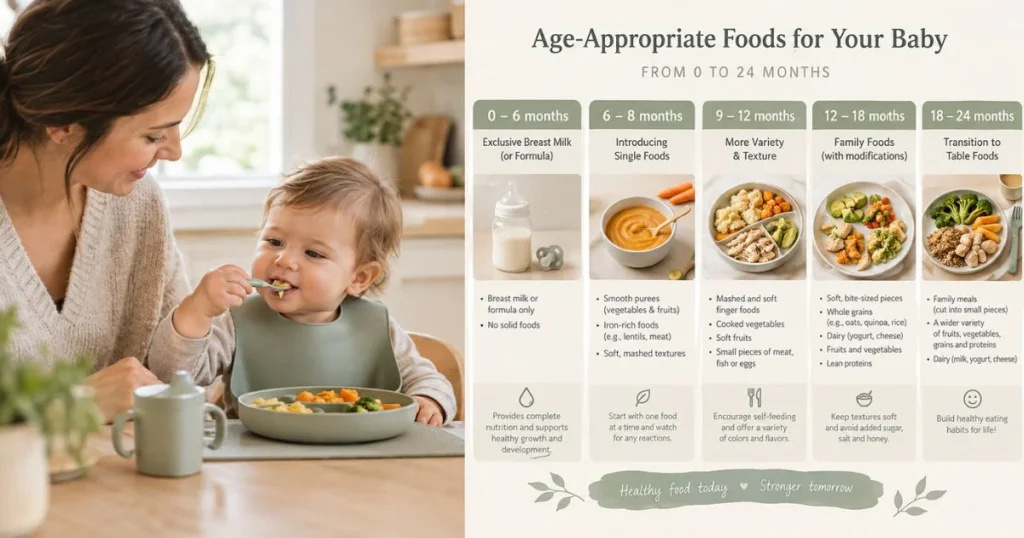
For simple ideas to build balanced toddler meals, explore our guide to Easy Toddler Meals.
You can also find more ideas for balanced midday meals in our Toddler Lunch Ideas guide.
For more simple family-friendly dinner inspiration, see our Toddler Dinner Ideas guide.
If you’re looking for easy options between meals, explore our Toddler Snack Ideas guide.
How Much Should a Baby Eat?
One of the most challenging parts of feeding a baby is knowing whether they are eating “enough.” The Baby Feeding Chart can provide general guidance, but there is no single portion size that works for every child.
Your baby may eat several spoonfuls at one meal and only a few bites at the next. Appetite can vary with growth, sleep, illness, teething, activity, and mood.
The CDC recommends beginning complementary foods with small portions, such as 1–2 tablespoons, and watching for signs that your child wants more or is becoming full.
Think progression rather than perfection
Early solids: A few tastes and small spoonfuls
7–8 months: Gradually increasing meal portions
9–11 months: More substantial meals and self-feeding practice
12+ months: Increasingly regular family meals and snacks
You do not need to pressure your baby to clean the plate.
If you’re looking for age-based feeding patterns, our Baby Feeding Schedule by Age guide provides additional examples.
Baby Hunger and Fullness Cues
A feeding schedule provides structure, but your baby provides the cues.
Learning those cues is one of the most important parts of responsive feeding.
Signs your baby may be hungry
Depending on your baby’s age and developmental stage, the Baby Feeding Chart may include hunger cues such as:
- Bringing their hands toward their mouth
- Turning toward the breast or bottle
- Opening their mouth
- Smacking or licking their lips
- Reaching toward food
- Becoming more alert when food is nearby
Crying is often a later sign of hunger, so recognizing earlier cues can help make feeding a calmer and more responsive experience.
Signs your baby may be full
Your baby may show signs of being full by:
- Turning their head away
- Closing their mouth
- Slowing down their feeding
- Stopping sucking
- Pushing food away
- Losing interest
- Becoming distracted
The Baby Feeding Chart should be used as a flexible guide rather than a reason to encourage your baby to finish a specific amount. When your baby shows signs of fullness, let them stop, even if some food or milk remains.
This is especially important with bottle feeding. Babies do not need to finish every bottle.
Breast Milk, Formula, Solids, and Water: How the Balance Changes
Your baby’s diet changes gradually rather than switching overnight.
Birth to about 6 months
In the early months, the Baby Feeding Chart centers primarily on breast milk and/or infant formula, which provide the nutrition and hydration your baby needs.
Water is generally not needed as a routine drink for young infants.
6–12 months
Throughout the first year, breast milk or infant formula continues to provide most of your baby’s nutrition while complementary foods gradually become a more important part of their diet. In the Baby Feeding Chart, water can also be introduced in small amounts as your baby begins eating solid foods.
For babies between 6 and 12 months, the CDC recommends offering about 4–8 ounces of water per day. Water should complement breast milk or infant formula rather than replace it during the first year.
12–24 months
By 12 months, your toddler can gradually get more of their nutrition from a varied diet of nutritious family foods. The Baby Feeding Chart can now focus more on balanced meals and snacks rather than infant feeding patterns.
At this age, you can introduce plain, pasteurized whole cow’s milk or an appropriate fortified, unsweetened dairy alternative. Water should also remain a regular everyday drink and be offered throughout the day.
For a more detailed month-by-month routine, see our Baby Feeding Schedule by Age guide.
Formula Preparation and Storage Safety

If your baby drinks infant formula, proper preparation and storage are essential for safe feeding. The Baby Feeding Chart can help you organize feeding patterns, but it does not replace the preparation instructions provided with your baby’s specific formula.
Always follow the manufacturer’s directions carefully. Never estimate the powder-to-water ratio or dilute prepared formula. The CDC recommends measuring the correct amount of water first and then adding the specified amount of formula powder according to the product instructions.
How long can prepared formula sit out?
According to current CDC guidance:
- Use prepared formula within 2 hours of preparation.
- Once feeding begins, use it within 1 hour.
- If prepared formula will not be used within 2 hours, refrigerate it immediately and use it within 24 hours.
- Throw away formula remaining in a bottle after a feeding.
- Never microwave a bottle because uneven heating can create dangerous hot spots.
Extra precautions may be needed for babies younger than 2 months, babies born prematurely, or babies with weakened immune systems because powdered formula is not sterile.
Foods and Drinks to Avoid or Limit
As your baby starts eating solid foods, food safety becomes an important part of the Baby Feeding Chart, alongside nutrition and feeding routines.
Avoid foods and drinks that are not appropriate for your baby’s age or developmental eating skills. Important examples include:
- Honey before 12 months
- Foods and drinks with added sugars
- Juice as a regular beverage
- Cow’s milk as a replacement for breast milk or infant formula before 12 months
- Unpasteurized foods or beverages
- Foods that may cause choking
- Foods that are hard, round, sticky, or difficult for your baby to chew or swallow safely
Choose textures, sizes, and shapes that match your baby’s developmental abilities, and always supervise your baby while they are eating.
For more detailed guidance on preparing and serving age-appropriate finger foods safely, see our Baby Finger Foods article.
What If My Baby Doesn’t Follow the Feeding Chart?
Your Baby Does Not Have to Follow the Chart Exactly
This may be the most important point to remember: your baby does not need to follow the Baby Feeding Chart exactly.
Think of the chart as a helpful framework, not a strict timetable. It can show you what feeding may look like at different ages, but it cannot predict exactly when your baby will be hungry or how much they will eat at every meal.
Your baby’s feeding pattern may change because they:
- Eat more often during a growth spurt
- Temporarily drink less milk as their interest in solid foods increases
- Eat very little when they are sick
- Ask for additional feeds at certain times of the day
- Sleep longer and naturally shift their feeding times
- Breastfeed more frequently than a sample schedule suggests
- Eat different amounts from one day to the next
The Baby Feeding Chart should therefore be used alongside your baby’s hunger and fullness cues. The CDC notes that children’s food intake can vary from day to day, particularly as they grow older. Instead of focusing on a specific amount at every meal, pay attention to the overall feeding pattern and your child’s growth and development.
Don’t turn the chart into a checklist
You do not need to ask yourself, “Did my baby finish the exact amount shown on the Baby Feeding Chart?”
A more useful question is:
“Is my baby growing well, feeding comfortably, responding to hunger and fullness cues, and gradually developing new eating skills?”
The Baby Feeding Chart is meant to provide general guidance, not a target your baby must meet at every meal. Feeding needs can vary from one child to another and can change as your baby grows.
If you have concerns about how much your baby is eating, their feeding behavior, or their growth, talk with your baby’s healthcare professional for individualized guidance.
When to Talk to Your Pediatrician
Although the Baby Feeding Chart can provide general guidance, it cannot replace individualized medical advice. Contact your baby’s healthcare professional if you have concerns about:
- Poor or inadequate weight gain
- Persistent refusal to feed
- Repeated vomiting
- Frequent coughing or choking during feeds
- Signs of dehydration
- Significant difficulty swallowing
- Ongoing distress during feeding
- A noticeable or persistent change in feeding behavior
- Whether your baby is receiving enough breast milk or infant formula
For newborns in particular, seek medical advice promptly if your baby is unusually difficult to wake, is feeding poorly, or you are concerned about hydration, feeding, or growth.
Frequently Asked Questions
How often should a newborn eat?
Newborns generally need frequent feeds. Breastfed newborns may feed as often as every 1–3 hours, while formula-fed newborns commonly feed about every 2–3 hours during the first days. As they grow, the time between feeds usually increases.
How much formula does a newborn need?
During the first days, a formula-fed newborn may start with about 1–2 ounces every 2–3 hours. The amount gradually increases as the baby’s stomach grows. Follow your baby’s hunger and fullness cues rather than forcing a specific volume.
When should babies start eating solid foods?
Most babies are ready for complementary foods at about 6 months when they show developmental readiness. Solid foods should not be introduced before a baby reaches 4 months of age.
How many meals should a 6-month-old eat?
A baby beginning solids may start with small amounts once or twice a day and gradually increase the frequency as they become more comfortable with eating. At this stage, breast milk or infant formula continues to provide most of your baby’s nutritional needs.
How many meals should a 9-month-old eat?
By 9–11 months, many babies are moving toward regular meals, often around three opportunities for solid food each day, while continuing breast milk or formula. Individual milk and food patterns vary.
When can babies drink water?
Water can be offered around 6 months when complementary foods begin. CDC currently recommends about 4–8 ounces per day for babies 6–12 months.
When can babies drink cow’s milk?
Plain, pasteurized whole cow’s milk can be introduced at 12 months. Until that time, cow’s milk should not be used as the main milk source in place of breast milk or infant formula.
Should milk come before or after solids?
Every baby is different, so there is no one-size-fits-all order for introducing foods. During the early stages of complementary feeding, breast milk or formula remains especially important. If your breastfed baby becomes less interested in nursing after solids, CDC suggests offering breast milk before other foods.
What if my baby eats less than the chart?
That can be normalYour baby’s appetite can change from one meal to the next and from one day to another. Look at the overall feeding pattern, growth, hydration, and developmental progress rather than expecting your baby to match a chart exactly.
Final Thoughts: Use the Chart as a Guide, Not a Rulebook
A Baby Feeding Chart can make the transition from frequent newborn feeds to family meals feel much easier to understand.
But the goal is not to make your baby follow a perfect schedule. Instead, the Baby Feeding Chart should help you build a predictable rhythm while remaining responsive to your child’s changing needs.
In the early months, that may mean frequent breast or bottle feeds. Around 6 months, small tastes of complementary foods gradually become more regular meals. Over the following months, your baby practices handling different textures, feeding themselves, and joining family mealtimes. By the toddler years, regular meals and snacks become a natural part of the family’s routine.
You do not need to get every feeding time exactly right.
What matters is creating a flexible routine that gives your child regular opportunities to eat, explore new foods, develop feeding skills, and grow.
Parenting Whisper Reminder
Every baby follows a unique feeding journey, so yours does not need to match anyone else’s. A schedule can give you structure, but your baby’s cues help you decide when to slow down, offer more, or simply try again later.er.